AI & automation.
Solve concrete problems, without unnecessary technology.
We use AI where it solves something simpler tools can't – and automation where a rule will do. The starting point is always the problem, not the technology.
Three tools, in the right order
We start at the bottom. Many problems are solved before we get to AI.
Automation
When something happens, the next thing happens by itself. A form becomes a task, a payment becomes a receipt. Simple rules solve more than many people think.
Integrations
Data flows between the systems you have, so nobody types the same thing twice.
AI
When the patterns are too many or too fuzzy to write as rules – or when the task is about text and language.
A concrete example: members dropping out of gyms
A new member who doesn't get going often quits quietly. At an unstaffed gym, nobody notices until the cancellation arrives. It's a concrete problem – and one where a rule isn't enough, because every member has their own pattern.
Data that already exists
Visits come from the door card. Members don't need to log anything.
The model looks for change
GymSustain's drop-out model looks for changes in the pattern of visits and activity.
An alert with an explanation
The member lands on the gym's work list – with why now, and a concrete suggestion.
A person acts on it
The gym or the PT decides what to do. The model makes no decisions.
The effect is measured
A random control group gets no follow-up, so the gym sees what the follow-up actually achieves.
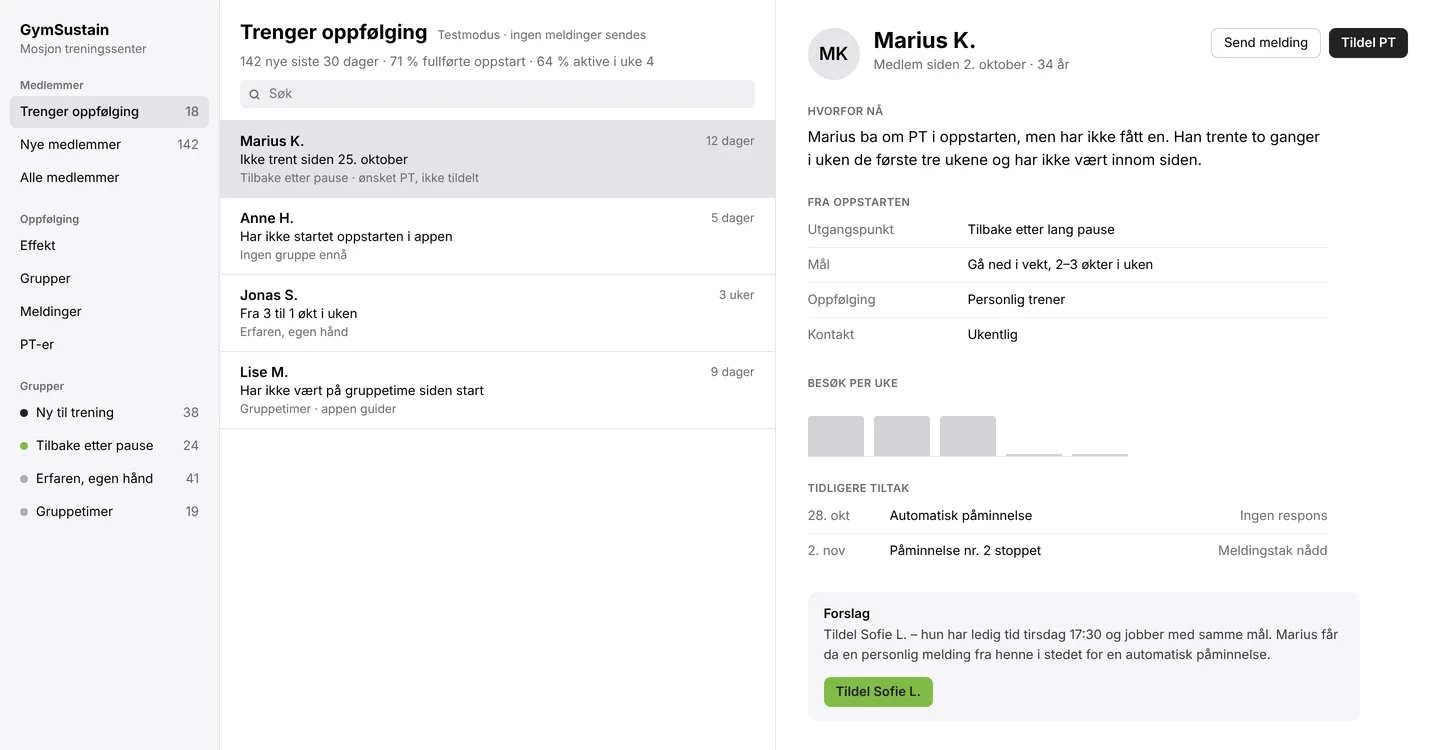
Before anything is sent to members, the model runs in test mode. We compare its alerts with who actually quits, and the gym sees for itself whether it's accurate.
Read about GymSustain →Status: GymSustain is fully built and ready for pilot. The model and the work list exist, but the impact has not yet been measured at a gym – that is what the pilots are for. The screenshot shows sample data.
Tasks that can often be automated
Examples of what we look for when we map out a working day:
- Enquiries that need sorting and sending to the right person
- Forms and emails that are typed into another system
- Reports put together by hand
- Anomalies in data that someone has to hunt for
- Customers who should be followed up before it's too late
- Long documents that have to be read to find what matters
Questions we ask before suggesting AI
- What does the problem cost you today – in time, money or customers?
- Does the data exist, and are you allowed to use it?
- Could a simple rule do the job just as well?
- What happens when the model is wrong, and who catches it?
- How do we measure whether things actually got better?
Privacy from the start
When a solution is about people, we build in consent, access control and as little data as possible from the first version – not afterwards. This is how we did it in GymSustain:
- Consent first
- Members choose what is shared, and can change it any time.
- Health only with the PT
- Injuries and considerations are only visible to the member's own PT.
- Not too much contact
- At most two messages a week across channels, and quiet hours in the evening.
- Honest about cancelling
- A pause is offered, but cancelling is always just as easy.
- Test mode first
- The model runs without sending anything until the gym has seen that it's accurate.
Which problem do you want to solve?
Tell us what takes time in your business – and we'll look into whether we can help. You'll hear back from the people who would build the solution.
Prefer email? christian@bikubai.com